Conversational AI bots have quickly moved from futuristic novelty to essential tools for modern businesses. These smart assistants act as virtual agents for scaling customer support, enabling teams to handle more requests while keeping interactions smooth and personal. Organizations exploring advanced AI often research distributed computing for AI workloads to understand how networks of computers can handle heavy processing and power sophisticated AI systems.
When implemented well, these solutions do more than answer questions — they streamline internal workflows and improve responsiveness across apps, websites, and messaging platforms. For guidance on the computing resources needed to run AI efficiently, companies can refer to high-performance computing setups for AI, which explain how infrastructure supports large-scale AI deployment and ensures your workforce management ai call center solutions operate reliably.
Beyond infrastructure, conversational AI bots can drive growth by analyzing customer behavior and enhancing engagement. Businesses can explore strategies for AI-driven marketing and customer engagement to learn how to connect with audiences more effectively. Smaller teams or startups may benefit from practical AI adoption case studies that show real-world ways conversational bots improve customer satisfaction and retention.
Finally, integrating AI into daily business operations is easier when following advice on managing AI technology in business processes, ensuring your conversational AI bot delivers measurable results without disrupting workflows.
This guide will explain what a conversational AI bot is, how it works, and, most importantly, how it can help your business achieve meaningful, measurable outcomes.
Top 10 Contact Center Solutions for Businesses Using Conversational AI Bots
As businesses increasingly adopt AI-powered tools, choosing the right contact center solution is critical. Conversational AI bots can streamline workflows, improve customer satisfaction, and scale support operations efficiently. Here are the top 10 contact center solutions currently shaping the market.
1. Bright Pattern – AI Contact Center Platform
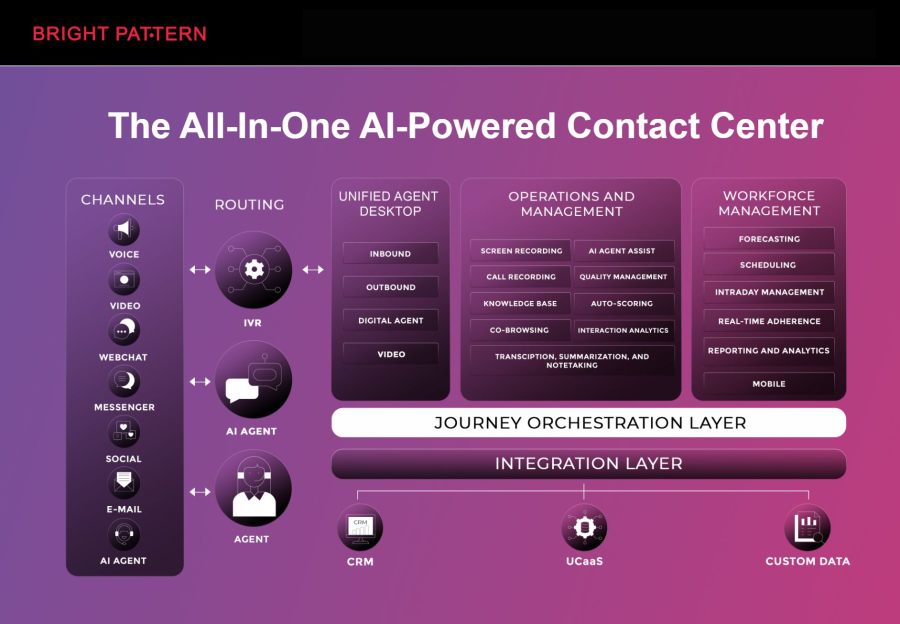
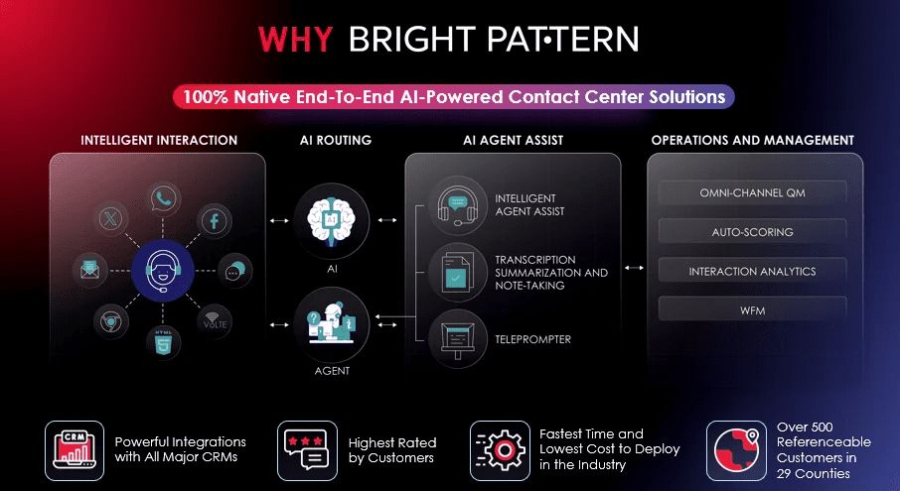
Bright Pattern is a leading contact center solution designed to deliver seamless customer experiences through conversational AI bots. It combines cloud-based architecture, advanced automation, and AI analytics to help businesses manage complex customer interactions.
Key features include:
- Omnichannel support for voice, chat, SMS, and social messaging
- Integration with CRM and business systems for streamlined workflows
- AI-driven routing and analytics to optimize agent performance
- Tools for workforce management and performance tracking
- Easy-to-use interface for both agents and administrators
Businesses using Bright Pattern can implement AI-driven call flows that automate routine inquiries while allowing human agents to focus on high-value interactions, ensuring faster resolution and higher customer satisfaction.
2. Genesys Cloud – Intelligent Customer Engagement
Genesys Cloud offers AI-powered customer engagement across multiple channels. Its conversational AI capabilities help businesses automate repetitive tasks, predict customer needs, and personalize experiences.
3. Five9 – Cloud Contact Center Software
Five9 provides a robust cloud contact center platform that integrates conversational AI bots for automated support. Its predictive dialing, workflow automation, and analytics improve both agent productivity and customer experience.
4. NICE inContact CXone – Omnichannel AI Contact Center
CXone by NICE inContact enables businesses to deliver seamless customer interactions across voice, chat, and digital channels. AI chatbots assist with routing, automated responses, and analytics-driven insights.
5. Talkdesk – AI-Powered Customer Service Platform
Talkdesk offers an intelligent contact center solution with AI-driven workflows and conversational bots. It supports real-time analytics and automated interactions that reduce response times and improve satisfaction.
6. Zendesk Talk – Cloud-Based Support System
Zendesk Talk combines phone, chat, and email support with AI automation. Conversational AI bots help manage incoming requests, freeing agents to focus on complex issues and improving operational efficiency.
7. Amazon Connect – Cloud Contact Center Service
Amazon Connect leverages AWS AI tools to provide scalable, cloud-based contact center solutions. Conversational AI bots can handle common inquiries, route calls intelligently, and integrate with other business services.
8. RingCentral Contact Center – AI and Analytics
RingCentral Contact Center uses AI to provide omnichannel support and intelligent routing. Automated chatbots and analytics help organizations optimize workflows and deliver faster, personalized responses.
9. 8x8 Contact Center – Intelligent Customer Engagement
8x8 offers an AI-enhanced cloud contact center with conversational bots to handle FAQs, appointment scheduling, and other routine tasks, while giving agents insights for better decision-making.
10. Avaya OneCloud – AI-Driven Support Platform
Avaya OneCloud integrates AI chatbots into contact center operations, providing predictive routing, real-time agent assistance, and analytics for improving customer experience and operational efficiency.
What Is a Conversational AI Bot?
Aconversational AI botis a software application that uses artificial intelligence to understand, process, and respond to human language in a natural, dialog-style way. Unlike traditional rule-based chatbots that rely purely on simple if/then scripts, conversational AI bots can interpret intent, manage context, and adapt their responses to feel more like a real conversation.
They usually operate via text (chat interfaces, messaging apps, SMS) and, in some cases, via voice (phone systems, voice assistants). The key advantage is that users can interact with your business using everyday language rather than navigating menus or filling out long forms.
How Conversational AI Bots Work (In Simple Terms)
While the technology under the hood can be complex, the basic flow is easy to understand. A typical conversational AI bot follows this journey for each user message:
- User input— The customer types (or speaks) a question or request, such as “Where is my order?” or “I want to upgrade my plan.”
- Understanding intent— The bot usesnatural language understanding(NLU) to determine what the user is trying to do (the intent) and to extract key details (entities) like dates, order numbers, or product names.
- Fetching information or triggering actions— The bot connects to your systems (for example, CRM, order management, or knowledge bases) to look up information or perform actions like updating an account or starting a support ticket.
- Generating a response— Using predefined conversation flows plus AI-driven language generation, the bot crafts a natural response tailored to the user’s request and context.
- Maintaining context— The bot remembers what has been said in the conversation so it can handle follow-up questions like “What about next week?” without asking the user to repeat themselves.
Underneath this flow, conversational AI bots rely on technologies such as:
- Natural language processing(NLP) to interpret text and extract meaning.
- Machine learning modelsthat improve performance over time as they see more examples.
- Dialog managementsystems that decide what the bot should say or do next.
- Integrations and APIsthat connect the bot to your business data and tools.
Key Benefits of Conversational AI Bots for Your Business
Modern conversational AI bots deliver clear, measurable benefits for both customers and teams. Here are some of the most impactful outcomes you can expect.
1. 24 / 7 Availability Without Burnout
Customers no longer operate on business hours — they research and buy at night, on weekends, and on their phones between other tasks. A conversational AI bot can be availablearound the clock, handling questions and requests anytime.
- Always-on servicemeans customers do not have to wait for a human agent to come online.
- Global reachis easier, because the bot can support different time zones and, when configured, multiple languages.
- Consistent qualityof responses, regardless of time of day or conversation volume.
2. Faster Answers and Happier Customers
People value speed. A conversational AI bot can respond in seconds, dramatically reducing wait times compared to email or phone support queues.
- Instant responses to common questions like shipping times, pricing, or account status.
- Guided, step-by-step help for complex tasks like onboarding or troubleshooting.
- Clear, consistent information drawn from your most up-to-date knowledge sources.
Faster responses translate intohigher customer satisfaction, better reviews, and stronger loyalty.
3. Lower Support Costs With Higher Efficiency
Conversational AI bots excel at absorbing a large share of repetitive inquiries that usually consume your support team’s time. This leads to tangible efficiency gains.
- Deflect routine ticketsby automating answers to FAQs, order status checks, password resets, and more.
- Handle large volumesduring peak seasons or campaigns without needing to rapidly scale headcount.
- Free human agentsto focus on complex, high-value issues that require empathy, negotiation, or in-depth expertise.
The result: you can serve more customers while keeping operational costs in check.
4. Increased Revenue and Conversions
Conversational AI bots are not only support tools. When designed with sales and marketing in mind, they can actively drive revenue.
- Lead qualification— Ask a few smart questions to identify high-intent visitors and route them to the right salesperson or experience.
- Personalized recommendations— Suggest products or plans based on user preferences, browsing behavior, or purchase history.
- Cart rescue— Engage users who seem stuck or about to abandon a cart, offering help or tailored incentives.
- Upsell and cross-sell— Proactively suggest add-ons or upgrades at relevant points in the conversation.
Because these interactions feel conversational instead of pushy, customers are more receptive, which can boost conversion rates.
5. Better Insights From Every Conversation
Every interaction with a conversational AI bot is a data point. When aggregated and analyzed, these conversations reveal what your customers truly care about.
- Identify frequently asked questions and friction points in your customer journey.
- Spot emerging trends in product feedback or feature requests.
- Discover language customers naturally use to describe their needs — valuable for marketing and product messaging.
These insights help you refine your website, product, pricing, and service approach in a data-driven way.
Popular Use Cases for Conversational AI Bots
Conversational AI bots can be tailored for different goals and departments across your organization. Here are some of the most common and effective applications.
Customer Support and Self-Service
This is often the starting point for many businesses. Support-focused bots can:
- Answer common questions about billing, orders, subscriptions, and policies.
- Guide users through troubleshooting steps for products or services.
- Collect details for more complex issues before handing off to a human agent.
- Provide order updates, appointment confirmations, or service alerts.
When designed well, a support bot becomes a friendly, always-available first line of help.
Sales Assistance and Product Discovery
For sales and e-commerce, conversational AI bots can act like digital sales associates.
- Ask discovery questions to understand a prospect’s needs, budget, and timeline.
- Recommend the best product, plan, or package based on those needs.
- Walk users through comparisons and answer detailed product questions.
- Capture lead details and schedule demos or appointments.
Instead of forcing visitors to browse complex menus, you offer a simple, human-like dialog that leads them to the right solution faster.
Marketing, Engagement, and Retention
Conversational AI opens new ways to engage and nurture your audience.
- Run interactive quizzes or product finders within a chat interface.
- Share personalized content recommendations, such as guides or resources, based on user interests.
- Gather feedback and run surveys without feeling intrusive.
- Re-engage existing customers with timely, relevant check-ins or offers.
Because the experience feels like a conversation rather than a one-way broadcast, engagement rates can be significantly higher.
Internal Automation and Employee Support
Conversational AI bots are just as powerful inside your organization as they are externally.
- HR and IT helpdesk— Answer questions about policies, benefits, devices, and access issues.
- Knowledge lookup— Help employees find documents, procedures, and how-to information quickly.
- Onboarding assistants— Guide new hires through tasks, training, and setup steps.
Internal bots reduce friction for your team, saving time and creating a smoother day-to-day work experience.
Conversational AI vs. Traditional Chatbots
Many people use the terms “chatbot” and “conversational AI bot” interchangeably, but there are important differences that affect user experience and business outcomes.
Aspect | Traditional Rule-Based Chatbot | Conversational AI Bot |
Understanding | Relies on exact keywords or pre-set button flows. | Uses natural language understanding to interpret intent and context. |
Flexibility | Struggles when users deviate from expected inputs. | Handles varied phrasing, follow-up questions, and corrections. |
Experience | Feels scripted and rigid; often frustrating when off-script. | Feels more natural, adaptive, and human-like. |
Maintenance | Requires manual updating of rules and flows. | Improves over time with data and training. |
Use cases | Best for very narrow, predictable tasks. | Works well across support, sales, marketing, and internal ops. |
In practice, many successful deployments combine structured flows (for reliability) with conversational AI (for flexibility), creating a balanced, user-friendly experience.
Key Features to Look For in a Conversational AI Bot
Not all bots are created equal. When you evaluate options or design your own solution, pay attention to these capabilities that strongly influence outcomes.
Natural Language Understanding (NLU) Quality
The heart of any conversational AI bot is its ability to accurately interpret what users mean. High-quality NLU should:
- Understand varied phrasing of the same question.
- Handle typos, informal language, and incomplete sentences.
- Recognize multiple intents within a single message when necessary.
- Extract key entities such as names, numbers, dates, and product identifiers.
Better understanding directly translates into fewer frustrating “I did not get that” moments.
Context and Memory
Strong conversational AI maintains context across turns in a conversation. This allows users to speak naturally, just as they would with a human.
- Remembering prior answers in the same session.
- Handling follow-ups like “What about the premium one?” or “Can you show me that again?”
- Optionally recalling preferences or history across sessions, when configured and consented.
Context-aware interactions feel smoother and reduce the need for repetitive input.
Easy Integration With Your Existing Systems
A conversational AI bot becomes truly powerful when it can act on real data instead of just providing static answers. Look for:
- Connectors or APIs for your CRM, helpdesk, e-commerce, and marketing tools.
- Ability to read and update records, not just display them.
- Secure handling of sensitive information like payment or personal data.
This connectivity is what allows the bot to check order status, update subscriptions, create tickets, and more — all within the chat.
Human Handoff and Collaboration
The goal is not to replace humans entirely but to help them shine where they add the most value. Effective bots include:
- Clear triggers for handing conversations to human agents when needed.
- Context transfer, so agents see the full conversation history and details.
- Options for agents to collaborate with or “coach” the bot for future improvements.
Well-designed handoff ensures users always feel supported and never trapped in an unhelpful loop.
Analytics, Training, and Continuous Improvement
Strong analytics turn your bot from a static tool into a learning system.
- Track metrics like resolution rate, response time, satisfaction, and escalation rate.
- Identify gaps where the bot did not understand or could not resolve issues.
- Continuously refine intents, responses, and flows based on real usage.
With an iterative approach, your conversational AI bot becomes more effective and valuable over time.
Designing a Great Conversational Experience
Technology alone does not guarantee success. The way you design the conversation matters just as much. Here are best practices that help your bot delight users.
1. Start With Clear Goals
Before building flows or training models, define exactly what you want your bot to achieve. Examples:
- Reduce support response times by a specific percentage.
- Increase online conversion rates or average order value.
- Improve self-service adoption for routine tasks.
Clear goals keep your design focused and make it easier to measure impact.
2. Map Real Customer Journeys
Talk to your support, sales, and marketing teams to understand common paths and pain points. Then, map typical conversations your bot should handle, such as:
- First-time visitor exploring pricing.
- Existing customer checking an order or subscription.
- User troubleshooting a specific error.
Designing around real journeys ensures your bot is useful from day one.
3. Use a Friendly, On-Brand Tone
People respond better to bots that communicate clearly and warmly. Craft responses that:
- Use simple, jargon-free language.
- Reflect your brand’s personality while staying respectful and professional.
- Set expectations honestly about what the bot can and cannot do.
A bot that is transparent and approachable builds trust quickly.
4. Provide Guidance and Quick Options
Open-ended conversation is powerful, but many users appreciate guidance. Combine free text input with smart prompts, such as:
- Suggested questions like “Track my order” or “See pricing.”
- Short menus for top tasks on first contact.
- Quick replies to speed up multi-step flows.
This hybrid approach helps users get value fast while still allowing natural language when needed.
5. Plan for Edge Cases and Recovery
No bot will understand every message perfectly, especially early on. What matters is how it recovers.
- Offer helpful clarifications when the bot is unsure, such as asking follow-up questions.
- Provide an easy path to a human agent when things get stuck.
- Avoid dead ends; always offer a next step or reset option.
Graceful recovery turns potential frustration into a neutral or even positive experience.
Measuring the Success of Your Conversational AI Bot
To keep your bot aligned with business goals, track performance over time. Useful metrics include:
- Containment rate— Percentage of conversations fully handled by the bot without human escalation.
- Resolution rate— How often the user’s issue is resolved in one interaction.
- Average response time— Speed of the bot’s replies compared to traditional channels.
- Customer satisfaction (CSAT)— Post-conversation ratings or feedback.
- Conversion and revenue impact— For sales-oriented bots, uplift in leads, sales, or order value.
- Cost per interaction— Comparison of automated vs. human-handled inquiries.
By tying these metrics back to your original goals, you can clearly demonstrate return on investment and identify areas for further optimization.
Strategic Advantages of Investing in Conversational AI Now
Adopting a conversational AI bot is more than a tactical upgrade; it is a strategic move that positions your business for the future of customer interaction.
- Meet rising expectations— Customers increasingly expect instant, personalized, omnichannel communication.
- Differentiate your brand— A polished, helpful bot experience can set you apart in crowded markets.
- Scale efficiently— As your business grows, conversational AI helps you handle volume without sacrificing quality.
- Future-proof your operations— Building conversational capabilities now makes it easier to adopt new channels and technologies later.
Businesses that embrace conversational AI early often see compounding benefits as the bot learns, the data grows, and new use cases are unlocked.
Bringing It All Together
A well-designed conversational AI bot is more than a chat widget. It is a smart, scalable assistant that:
- Provides instant, round-the-clock support.
- Drives sales with personalized guidance and recommendations.
- Boosts customer satisfaction and loyalty.
- Reduces operational costs while increasing capacity.
- Generates valuable insights from every interaction.
By combining advanced language understanding with clear goals, thoughtful design, and continuous improvement, you can transform everyday conversations into a powerful engine for growth and customer success.
Whether you are streamlining support, energizing your sales funnel, or empowering your internal teams, a conversational AI bot offers a practical, high-impact way to move your business forward.
